Most people think tax rises happen in obvious ways: the government increases income tax, raises National Insurance, or hikes VAT. Those moves are headline-grabbing, politically risky, and easy to spot on a payslip.
But there’s another kind of tax rise that happens quietly, gradually, and often without a single vote in Parliament for a higher rate. It’s called fiscal drag — and it’s one of the biggest reasons many workers feel worse off even when their salary goes up.
Fiscal drag is sometimes described as a “stealth tax”. That phrase can be overused, but in this case it fits. It’s a mechanism that increases the tax burden over time, simply by leaving thresholds frozen while wages and prices rise.
What is fiscal drag?
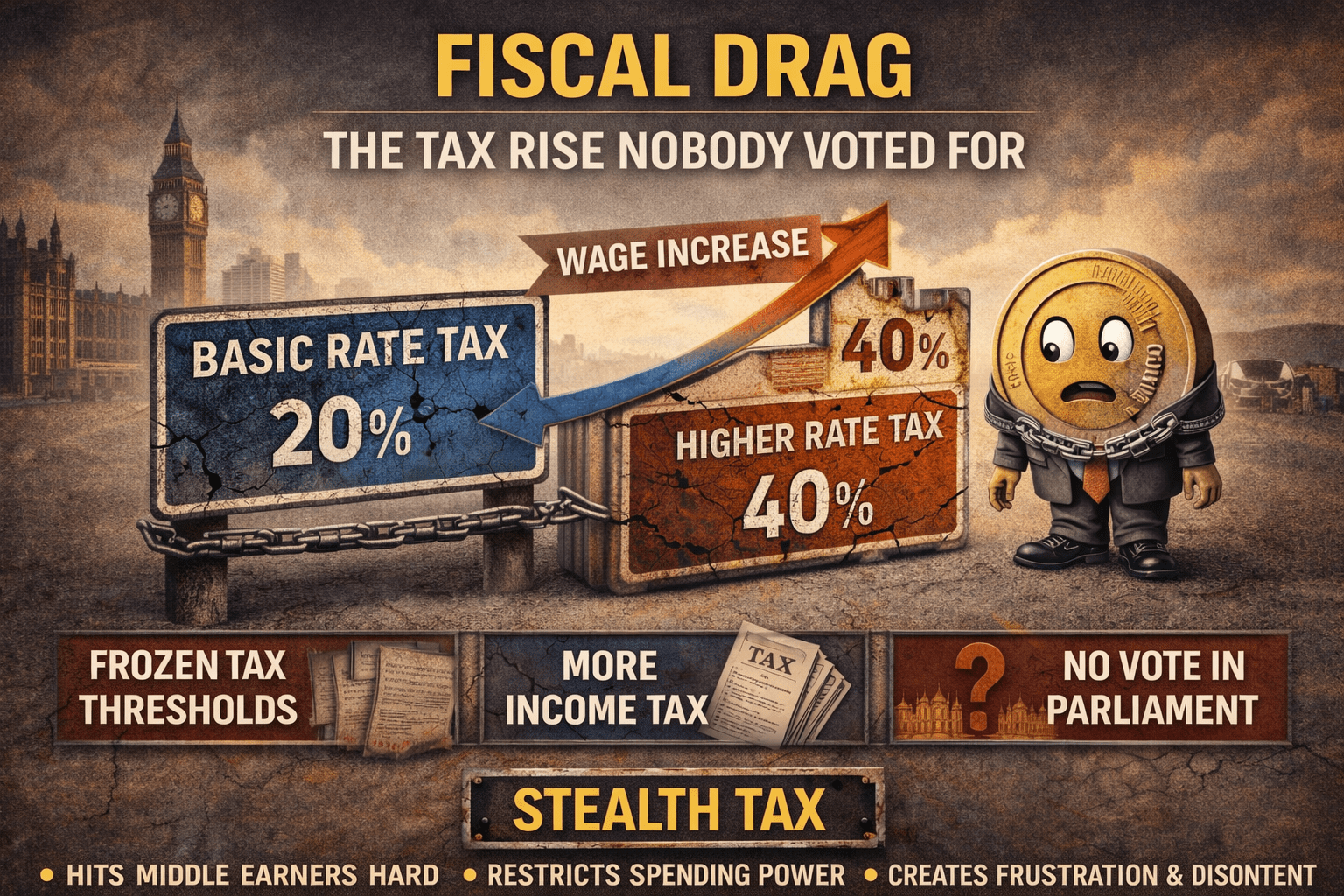
Fiscal drag happens when tax thresholds and allowances don’t rise in line with inflation or earnings.
In the UK, income tax works through bands: you pay a certain rate up to a threshold, then a higher rate on income above it. If those thresholds stay fixed while wages rise, more people get pulled into higher tax bands, and a bigger share of their income gets taxed at higher rates.
Crucially, this can happen even if tax rates never change.
A simple example: if you earn £49,000 and get a pay rise to £52,000, you may feel like you’ve moved forward. But if the higher-rate threshold is frozen, part of your pay rise might now be taxed at 40%. You’re earning more, but the state takes a larger slice.
Multiply that across millions of workers and the effect is substantial.
Why governments like it
Fiscal drag is attractive to governments for one main reason: it raises revenue without the political pain of announcing a tax increase.
A chancellor can stand up and say, “We’re not raising income tax,” while still collecting more from taxpayers year after year. It’s not necessarily dishonest — it’s just a different lever. But it’s a lever most people don’t notice until it hits them.
In times of weak growth and high public spending pressures, fiscal drag becomes even more tempting. Governments need money to fund services, debt interest, and commitments — but they also want to avoid backlash. Freezing thresholds is a neat solution: quiet, effective, and hard to explain in a soundbite.
Who gets hit hardest?
Fiscal drag doesn’t affect everyone equally. It hits certain groups more than others, especially:
Middle earners
Not the very highest earners (who are already paying top rates), but people in the broad middle — those receiving steady pay rises, promotions, or moving from early career to mid-career salaries.
Dual-income households
Two salaries rising in parallel can push household income into higher tax territory faster than expected, even if neither individual feels “rich”.
People in high-cost areas
In London and the South East, wages may be higher, but so are housing and childcare costs. Fiscal drag can make these households feel squeezed: they pay more tax while still struggling with everyday expenses.
Public sector workers receiving catch-up rises
When governments raise pay to ease recruitment pressures or respond to strikes, fiscal drag can claw back part of that increase through higher taxation.
The psychological effect: “I got a raise but I’m poorer”
One reason fiscal drag causes such frustration is that it creates a mismatch between effort and reward.
People work harder, take on more responsibility, or switch jobs for higher pay — and yet their disposable income doesn’t rise as much as expected. Some even feel like they’re going backwards.
That isn’t always because taxes are “too high” in isolation. It’s because the system is quietly changing around them. If inflation has been high, and thresholds don’t move, then even keeping up with the cost of living can mean paying more tax.
This contributes to a wider sense that the economy is unfair or rigged — not necessarily because of dramatic corruption, but because the rules feel invisible and unresponsive.
The economic impact: less spending power, weaker growth
Fiscal drag doesn’t just affect individuals. It has macroeconomic consequences too.
When households lose disposable income, they cut back on spending. That reduces demand across the economy, particularly in sectors that rely on discretionary consumption: retail, hospitality, leisure, and services.
At the same time, fiscal drag can discourage additional work. If overtime, promotions, or second jobs push people into higher tax bands, the reward for extra effort shrinks. Over time, that can weaken labour supply and productivity.
In other words: fiscal drag can be good for the Treasury in the short term, but it may be a drag on growth in the long term.
Is fiscal drag “bad policy”?
Not always. Governments have to raise revenue somehow, and freezing thresholds can be a practical tool during difficult periods. It’s also true that progressive taxation — where higher earners pay more — is a legitimate political choice.
The issue is transparency.
If the tax burden is rising, it should be openly debated. Fiscal drag makes that harder, because it spreads the pain quietly and gradually. It’s taxation by default rather than by decision.
A government that relies heavily on fiscal drag is effectively saying: we will raise more money, but we won’t clearly tell you how much or who will pay it until it happens.
The bottom line
Fiscal drag is one of the most significant “hidden” economic forces shaping household finances in the UK today. It doesn’t require a single tax rate to rise. It doesn’t need a new law to grab headlines. It works through inertia.
For millions of workers, it means the same reality: pay rises don’t stretch as far as they should, the tax take creeps upward, and the feeling of being squeezed becomes the new normal.
In the end, fiscal drag is a reminder that in economics, what matters isn’t just the rate you pay — it’s the thresholds, the context, and the quiet mechanisms that shape your take-home pay.
ffice for Budget Responsibility. (2024). Economic and fiscal outlook – March 2024. Office for Budget Responsibility. https://obr.uk/efo/economic-and-fiscal-outlook-march-2024/
Institute for Fiscal Studies. (2023). Income tax threshold freezes and fiscal drag. Institute for Fiscal Studies. https://ifs.org.uk/
HM Revenue & Customs. (2024). Income Tax rates and allowances. GOV.UK. https://www.gov.uk/income-tax-rates