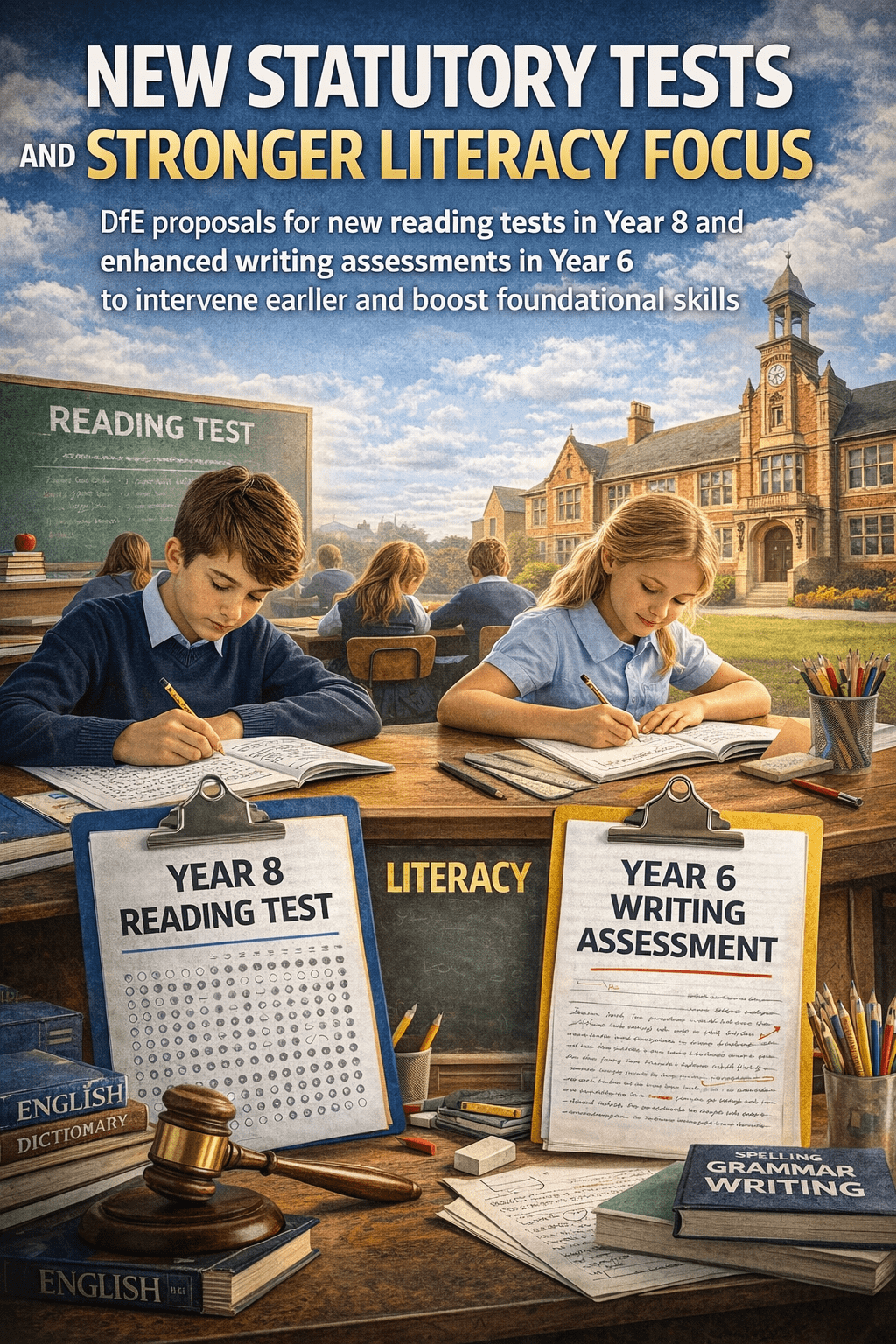
The Department for Education is proposing a new wave of statutory literacy assessments, including a reading test in Year 8 and stronger writing checks in Year 6, in a bid to identify struggling pupils earlier and intervene before gaps become entrenched.
Ministers argue the changes are designed to strengthen foundational skills — particularly reading fluency, comprehension, spelling and extended writing — which are increasingly seen as the key predictors of long-term attainment across the curriculum. Under the proposals, schools would be expected to use the new data to target support sooner, rather than waiting for weaknesses to show up later in GCSE performance.
A senior government source said the aim is “to ensure no child slips through the net after primary school”, describing literacy as “the gateway to success in every subject, from science to history”.
Supporters say earlier, clearer diagnostics could help schools direct resources more effectively, especially for pupils who fall behind during the transition from primary to secondary education. “Year 7 and Year 8 are where small gaps can quickly become big ones,” said one literacy specialist. “If you can spot the problem early — whether it’s decoding, vocabulary, or writing stamina — you have a better chance of closing it.”
But critics warn that expanding statutory testing risks increasing pressure on pupils and teachers, and may encourage “teaching to the test” rather than improving broader reading habits and writing quality. School leaders have also raised concerns about workload, including moderation demands for writing assessment and the administrative burden of additional national reporting.
The proposals sit within a wider government push to raise standards in core subjects, with literacy framed as essential not only for academic outcomes but also for employability and social mobility. If implemented, the reforms would mark a further shift towards earlier intervention — and a more data-driven approach to measuring progress beyond Key Stage 2.
Official Government and Policy Sources
- UK Government — Focus on reading in secondary years to drive up standards
Government statement on introducing a statutory reading assessment in Year 8, emphasising reading fluency and comprehension.
https://www.gov.uk/government/news/focus-on-reading-in-secondary-years-to-drive-up-standards - UK Government Response to the Curriculum and Assessment Review (PDF)
Official document confirming the introduction of a statutory Year 8 reading test and strengthened writing assessment at Year 6, with broader curriculum reform context.
https://assets.publishing.service.gov.uk/media/690b2a4a14b040dfe82922ea/Government_response_to_the_Curriculum_and_Assessment_Review.pdf - UK Parliament (Hansard) — Curriculum and Assessment Review debate
Parliamentary record on the introduction of a statutory Year 8 reading test and related assessment changes as part of the review response.
https://hansard.parliament.uk/commons/2025-11-05/debates/D2C0311B-E906-48E8-A269-9018F5062362/CurriculumAndAssessmentReview
🗞️ Independent and Education News Coverage
- Schools Week — Year 8s to sit mandatory reading test under white paper plans
Reporting on the government’s plan to introduce a compulsory Year 8 reading test in the upcoming schools white paper.
https://schoolsweek.co.uk/year-8s-to-sit-mandatory-reading-test-under-white-paper-plans/ - The Independent — Compulsory reading test to be introduced for 13-year-olds
Coverage of proposals for mandatory reading assessment for Year 8 pupils, with responses from unions and sector sources.
https://www.independent.co.uk/news/uk/home-news/reading-test-year-8-schools-education-b2834239.html