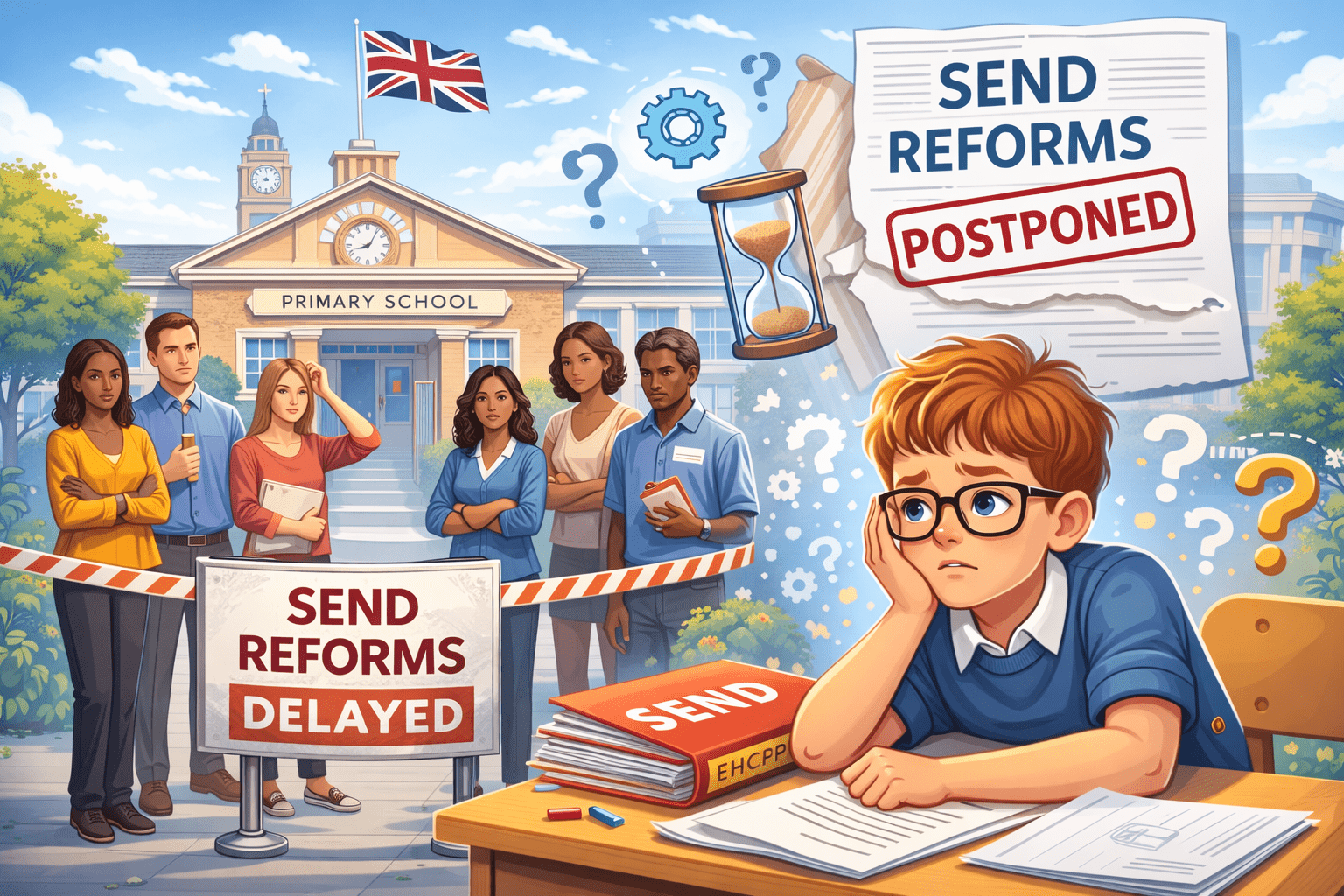
Government Postpones SEND Rights Reforms — Uncertainty Returns to an Already Strained System
The UK government has postponed planned reforms to Special Educational Needs and Disabilities (SEND) rights, delaying changes that were expected to reshape how children and young people access support in schools and through local authorities.
While the government frames the pause as a matter of timing and getting reforms “right”, the delay lands in a system already under intense strain — where demand is rising, provision is uneven, and many families feel they have to fight for support that is supposed to be guaranteed.
What SEND rights reforms were expected to address
SEND reform has been circling the system for years, largely because the current framework often produces the same outcomes:
- long waits for assessments and Education, Health and Care Plans (EHCPs)
- patchy provision depending on postcode and local authority capacity
- increasing use of tribunals and appeals as a route to secure support
- financial pressure on councils, schools, and specialist services
- frustration and burnout among families, teachers, and SEND professionals
Reforms were expected to tackle some combination of standards, eligibility, accountability, and early intervention — all areas where the system struggles to meet legal expectations in practice.
Why postponement matters (even if nothing changes tomorrow)
In the short term, delaying reform means the current system remains in place. But politically and practically, the postponement matters because it prolongs uncertainty for the people most affected.
1) Families are left in limbo
Parents and carers planning next steps — a new assessment, a school move, a tribunal, a transition to secondary school — now face a familiar problem: they don’t know what the rules will look like in six months or a year.
For many, that uncertainty isn’t just inconvenient. It can shape decisions about schooling, work, childcare, and finances.
2) The gap between “rights” and reality keeps widening
SEND is one of the clearest examples of a UK policy problem where rights exist on paper, but delivery is inconsistent on the ground.
Children may have legal entitlements, but those entitlements rely on:
- local authority staffing and budgets
- specialist availability (speech and language therapy, CAMHS-linked support, occupational therapy)
- school capacity and training
- clear, enforceable accountability
When reform is delayed, the mismatch between legal promise and service capacity remains unresolved.
3) Tribunals remain the pressure valve — and an unequal one
One of the biggest structural problems in SEND is that enforcement often comes down to whether families can endure a long, technical, and stressful appeals process.
That creates inequality: families with more time, knowledge, and resources are better placed to challenge decisions, while others are more likely to accept inadequate support or give up.
Without reform, the tribunal system risks staying as the default route for securing provision — which is expensive, adversarial, and emotionally draining.
What this delay suggests about government priorities
Postponing SEND reforms can be read in two ways.
A cautious interpretation: “complex system, high stakes”
SEND touches education, health, and social care — and reforming it means coordinating across departments, local authorities, and frontline services. It is genuinely difficult to change without unintended consequences, especially if reforms alter eligibility thresholds or funding responsibilities.
A harsher interpretation: “kicking the can down the road”
SEND reform is politically risky. Any change can be framed as either:
- too weak (fails to fix the crisis), or
- too harsh (cuts or restricts rights)
Delaying reform can therefore look like a way of avoiding confrontation while pressures continue to build — particularly when budgets are tight and public services are already overstretched.
The wider context: SEND demand is rising
Even without any policy change, the SEND system has been moving in one direction: more children needing support, more complex needs, and more families seeking EHCPs because mainstream provision often cannot cope without formal plans attached.
This doesn’t necessarily mean children are “more difficult” or schools are failing — it may reflect a mix of:
- better recognition and diagnosis
- rising mental health and developmental pressures post-pandemic
- stretched early-years support
- fewer specialist placements available
- mainstream schools struggling with staffing and resources
The longer reform is delayed, the more the system relies on short-term coping strategies: temporary support, inconsistent provision, and reactive crisis management.
What happens next
For now, the legal framework stays the same. That means:
- EHCP duties remain in force
- local authorities remain responsible for assessments and provision
- families still have the right to challenge decisions through appeals and tribunals
But the political pressure will not go away. SEND is now one of the most visible stress points in public service delivery, with impacts that are immediate and personal — affecting children’s education, parents’ ability to work, and schools’ capacity to function.
Bottom line
Delaying SEND rights reforms may buy the government time, but it also extends uncertainty for families and schools already navigating a system under heavy strain. Without clear action, the risk is that “rights” continue to depend less on entitlement and more on endurance — with the tribunal system acting as the unofficial gateway to support.
If the government wants to rebuild trust, the next step can’t simply be another review. It needs a credible timeline, measurable standards, and a plan that matches legal promises with real-world capacity.
Primary sources about the delay
- Independent. (2025, October 22). Government Send reforms in white paper to be delayed until new year. The Independent. Retrieved from https://www.independent.co.uk/news/uk/home-news/bridget-phillipson-schools-government-education-select-committee-helen-hayes-b2850175.html
- IPSEA. (2025, October 23). Government delays publication of Schools White Paper on SEND reform until 2026. IPSEA. Retrieved from https://www.ipsea.org.uk/news/government-delays-publication-of-schools-white-paper-on-send-reform-until-2026
- Education Executive. (2026, January 5). Government White Paper on SEND reform delayed. Education Executive. Retrieved from https://edexec.co.uk/news-government-white-paper-on-send-reform-delayed/
- Parliamentary Research Briefing. (2025, December 17). Special Educational Needs: support in England (SN07020). House of Commons Library. Retrieved from https://commonslibrary.parliament.uk/research-briefings/sn07020/
Commentary and reactions
- Liberal Democrats. (2025, October 22). SEND provision reform delay: “an absolute betrayal”. Liberal Democrats. Retrieved from https://www.libdems.org.uk/press/release/send-provision-reform-delay-an-absolute-betrayal