The civil service is meant to be the administrative backbone of government, responsible for turning political decisions into action.[1] Instead, it has become a case study in how the size of the state expands almost regardless of who is in power.
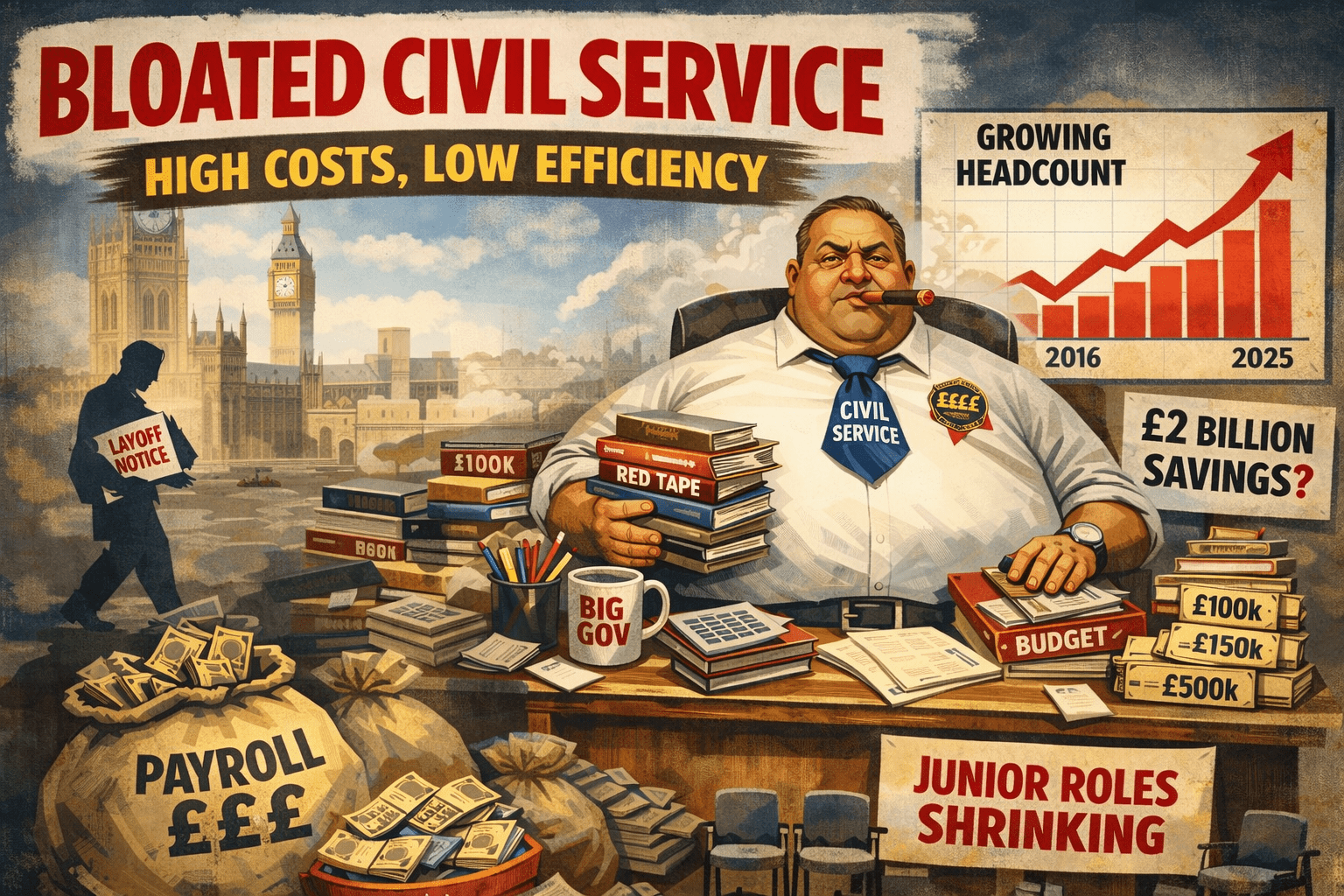
Despite repeated commitments to reduce numbers, the civil service remains significantly larger than it was before the pandemic — and far larger than in 2016. For taxpayers, the result increasingly resembles a system that is “bloated and inefficient”, delivering higher costs without clear improvements in outcomes.[2]
The coronavirus pandemic is often used to justify this expansion. Staffing did surge during that period, but the real failure came afterwards. Emergency growth was never unwound. Temporary measures quietly became permanent. Even as public finances tighten, civil service headcount continues to rise rather than retreat.
The chancellor of the exchequer has argued that this trend can be reversed, stating that cutting 10,000 civil service jobs could save more than £2 billion a year by the end of the decade.[3] On paper, the ambition sounds bold.
The 2025 spending review reinforced this message, committing departments to an 11 per cent real-terms cut in administration budgets between 2025–26 and 2028–29, followed by a further 5 per cent reduction in 2029–30, as part of a wider effort to shrink the state.[4]
Reality check
Since 2016, the civil service has expanded by 131,320 staff. Without decisive reductions in headcount — particularly at senior levels — budget cuts risk becoming little more than accounting exercises.
Yet these plans look increasingly disconnected from reality. This expansion is not marginal or temporary — it is structural growth. Without decisive reductions in headcount, particularly at senior levels, budget cuts risk becoming little more than accounting exercises.
The latest briefing note — the third in this series — shows where this expansion is taking place and why meaningful reform remains elusive. The data reveals a civil service that continues to grow, rewards seniority, and sheds junior roles, all while claiming to pursue efficiency.
By the numbers
- Total employment (March 2025): 549,660 — the ninth consecutive annual increase.
- Largest single expansion: 2021, when staffing rose by 6.3 per cent (+28,525 roles).
- £100,000+ earners: up 20 per cent in a single year.
- £150,000–£200,000 earners: up more than 44 per cent.
- Administrative officers and assistants: down 4,580 roles.
Put simply, the civil service is shrinking at the bottom while growing at the top.
The cost implications are unavoidable. The total civil service salary bill in 2025 is estimated at £21 billion — a 7.3 per cent increase on 2024 and far outpacing growth in the wider UK economy.[5]
This trajectory is incompatible with claims of restraint, efficiency or value for money.
If the government is serious about reforming the state, it must confront an uncomfortable truth: cutting budgets without cutting headcount — and without challenging the growth of senior roles — will not deliver genuine reform. Until the civil service itself begins to shrink, promises of efficiency will remain just that: promises.
References
- [1] Civil Service, About us, GOV.UK (accessed 4 November 2025).
- [2] Martin, D. & Butcher, B., How the bloated Civil Service is failing Britain, The Telegraph, 25 March 2025.
- [3] Sky News, Civil service to axe 10,000 jobs, Chancellor Rachel Reeves says – as she eyes cutting £2bn in costs, 24 March 2025.
- [4] Worlidge, J., Rachel Reeves’ spending review aims for a smaller, more efficient civil service, Institute for Government, 12 June 2025.
- [5] Office for Budget Responsibility, Economic and Fiscal Outlook, November 2025, pp. 6–7.