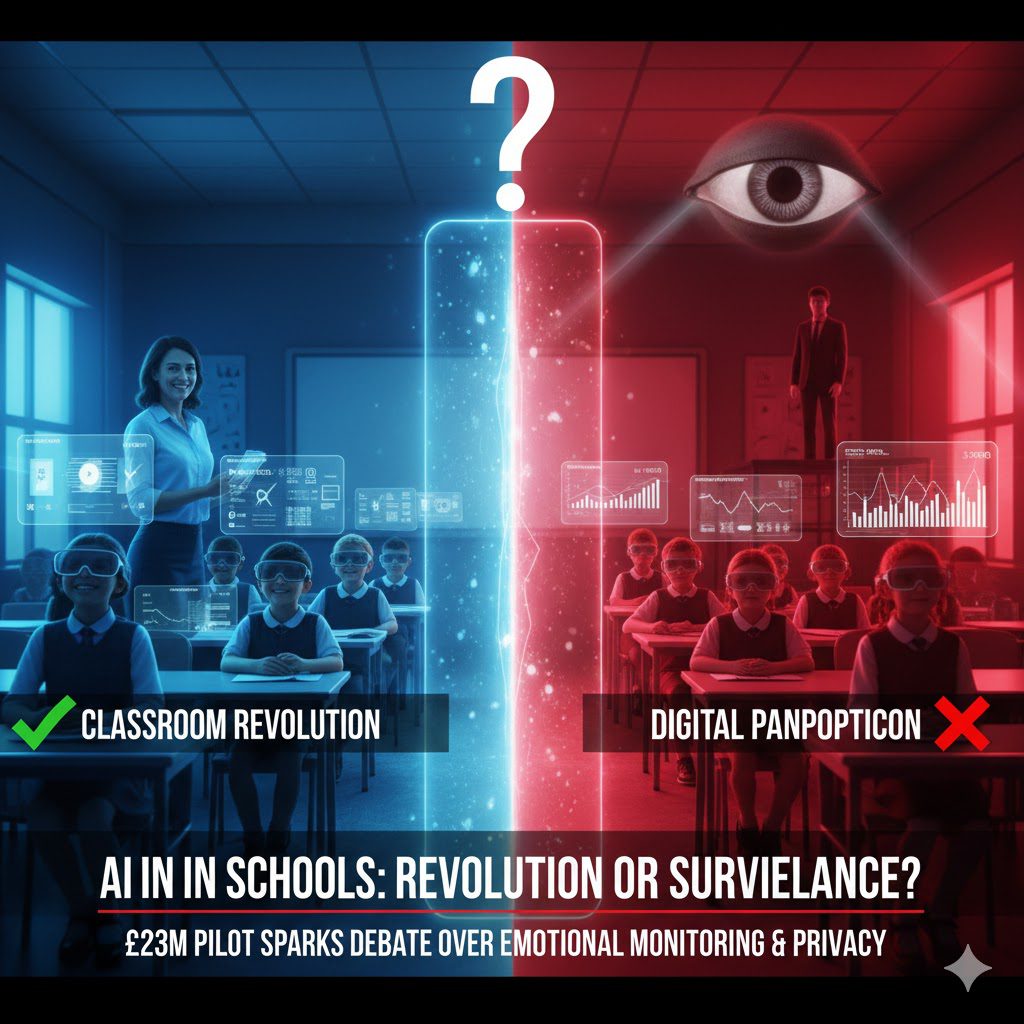
Is it a classroom revolution or a digital Panopticon? The government’s new £23 million AI pilot promises to “supercharge” learning, but its plan to use algorithms to detect “learner distress” is sparking a fierce national debate.
Speaking at the BETT UK 2026 conference this week, the Education Secretary announced the massive expansion of the government’s EdTech Testbeds. Branding AI as the “biggest leap forward for learning since the printing press,” the Department for Education (DfE) confirmed that over 1,000 schools and colleges will now trial cutting-edge “emotional AI” tools.
The Feature Under Fire: Emotional Monitoring
While much of the £23m investment is aimed at “invisible” tasks like automated marking and lesson planning, the most controversial pillar of the programme is Real-Time Sentiment Analysis.
The pilot will utilize software designed to track pupil engagement through data patterns. By analyzing typing speed, interaction frequency, and even subtle changes in student responses, the AI aims to:
- Identify “Silent” Struggles: Alerting teachers to students who are physically present but mentally “checked out” or distressed.
- Flag Mental Health “Red Flags”: Highlighting sudden shifts in a student’s tone or output that may indicate a burgeoning mental health crisis.
- Predict Burnout: Identifying when a student is becoming overwhelmed by the complexity of a task before they reach a “meltdown” point.
A Game-Changer for SEND?
Proponents of the pilot, including many neurodiversity advocates, argue that AI is a “leveler.” The programme includes Generative AI tools that can:
- Instantly Simplify Language: Re-writing complex textbook passages into “Easy Read” formats for students with learning disabilities.
- Voice-to-Visuals: For non-verbal students, AI can translate speech or text into instant visual icons or symbolic communication.
- Adaptive Scaffolding: Tools like Google’s “Writing Coach” provide a step-by-step guide through essay writing, offering real-time feedback without the student needing to wait for a teacher to become free.
The Privacy Watchdog Warning
Despite the potential benefits, the pilot has been met with immediate resistance from privacy groups like Defend Digital Me. Critics argue that the government is turning classrooms into data-collection labs.
“We are talking about software that attempts to read the emotional state of a child,” says Jen Persson, Director of Defend Digital Me. “Who owns this data? How long is it kept? And what happens if a ‘false positive’ labels a child as ‘distressed’ or ‘unstable’ in their permanent record?”
The Screen Time Contradiction
The announcement has left many headteachers scratching their heads. Only last week, the DfE reaffirmed its stance on banning mobile phones in all English schools to reduce “digital noise.” The Education Secretary addressed this directly at BETT, stating that while consumer social media is a “distraction,” institutional AI is “essential” for a 2026 economy.