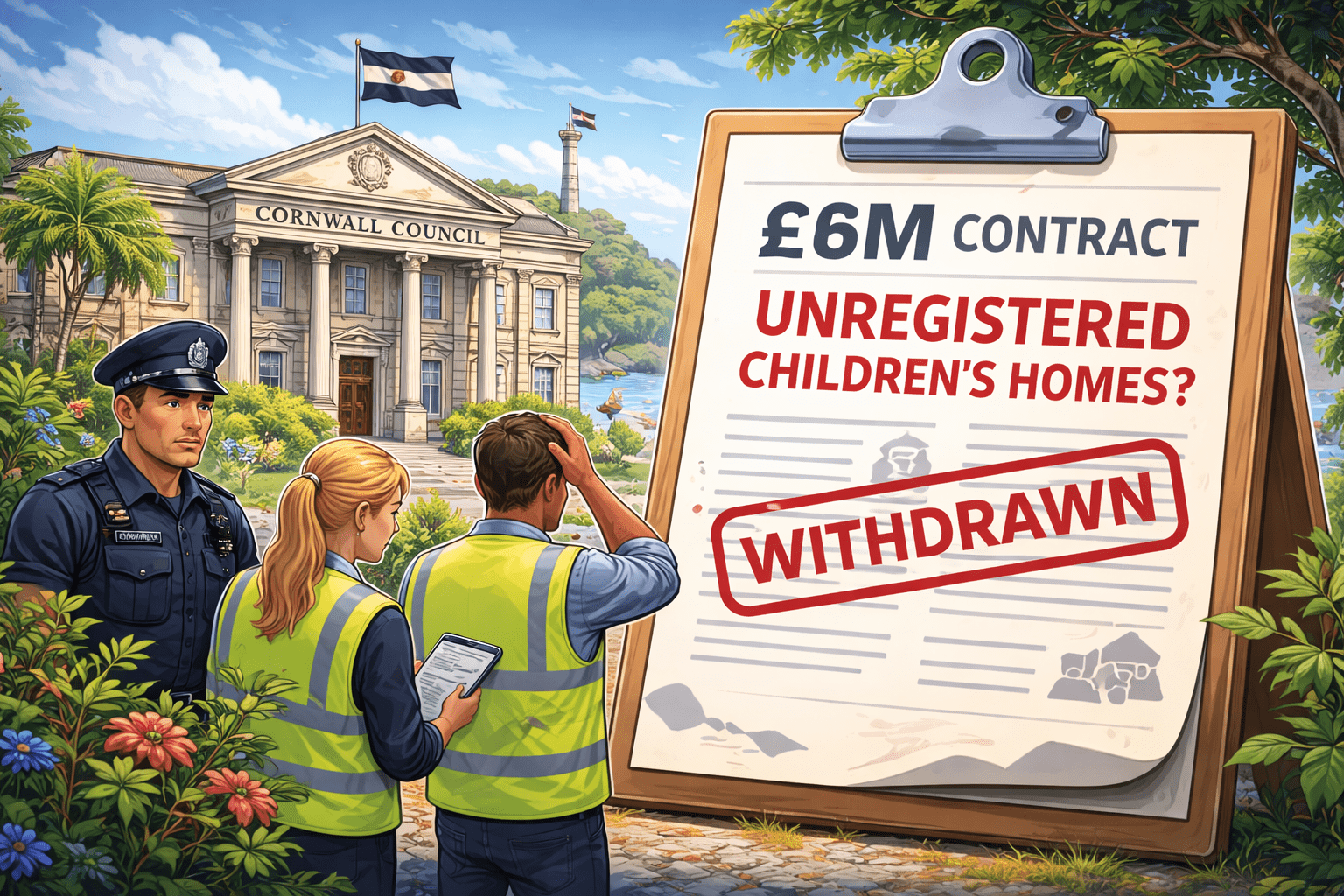
Cornwall Council has been forced to withdraw a controversial £6 million notice that appeared to seek staff for children’s homes that are not registered with Ofsted — settings that, under English law, are illegal to operate. The advertisement, published on the government’s Find a Tender procurement portal, described the opportunity as “staffing for unregistered places”, prompting intervention from Ofsted and national officials before it was removed.
Under the Care Standards Act 2000, it is a criminal offence to run a children’s home that is not registered with Ofsted, because registration ensures homes meet safety, staffing and quality standards and are subject to routine inspection. The original Cornwall notice explicitly referenced unregistered placements, signalling a willingness to legitimise settings outside that regulatory framework.
The council said the notice was not a formal contract but a “soft market test” to gauge what staffing solutions might exist for children with highly complex needs, particularly in situations where suitable regulated placements are hard to secure. It acknowledged the wording was misleading and withdrew the notice.
The intervention was sparked by a complaint from the Children’s Homes Association, which represents registered providers. Its chief executive described the advertisement as “disappointing and shocking”, warning that unregistered homes lack the oversight needed to keep vulnerable children safe.
A Wider National Issue
Cornwall’s episode reflects a broader and growing challenge across England’s children’s social care system. Recent reports show hundreds of vulnerable children are living for extended periods in unregistered and unregulated settings — often because councils cannot find suitable registered homes, particularly for young people with complex behavioural or mental health needs.
Data from the Children’s Commissioner’s office suggests there were hundreds of children in illegal placements as recently as 2025. These placements — sometimes in holiday lets, caravans or other unregistered residences — fall outside Ofsted inspection and are associated with higher safeguarding risk and significantly higher costs to councils.
Although councils say unregistered placements are a last resort, enforcement is weak: operating an illegal children’s home is rarely prosecuted, and councils often argue they have no alternative when there are no registered beds available.
Why It Matters
Registered children’s homes are subject to annual Ofsted inspections as well as regular safeguarding and standards checks. These mechanisms are designed to protect children’s welfare and ensure homes have properly trained and vetted staff. Without them, there is no independent assurance that care is safe, stable, or of good quality — particularly for children with high needs.
Critics say Cornwall’s procurement notice may have normalised the use of unregistered placements at a time when the system is already under stress. A shrinking number of secure or specialist registered homes, rising demand for placements, and high costs in the private market are pushing councils into emergency solutions that sit uncomfortably with legal obligations and safeguarding expectations.
What Happens Next?
In response to mounting pressure, government legislation currently progressing through Parliament — including the Children’s Wellbeing and Schools Bill — seeks to strengthen oversight of children’s homes and give Ofsted new powers to penalise unregistered providers. But these changes are not yet in force, and campaigners argue more urgent action is needed.
Cornwall Council’s case highlights how acute the placement crisis has become: even advertised market engagement on unregistered provision can rapidly attract national scrutiny. For children, families and social workers, the episode is a stark reminder that legal entitlement to quality residential care, and practical availability, can be out of step — with potentially serious consequences for some of the most vulnerable young people in the country.
The Bureau of Investigative Journalism
The Bureau of Investigative Journalism. (2025, November 13). Cornwall council offered suppliers £6m to run illegal children’s homes. The Bureau of Investigative Journalism. https://www.thebureauinvestigates.com/stories/2025-11-13/cornwall-council-offered-suppliers-6m-to-run-illegal-childrens-homes
The Bureau of Investigative Journalism. (2026, January 16). New report reveals shocking prevalence of illegal children’s homes. The Bureau of Investigative Journalism. https://www.thebureauinvestigates.com/stories/2026-01-16/new-report-reveals-shocking-prevalence-of-illegal-childrens-homes
Local / regional reporting
Cornish Times. (2025, November 2025). Council withdraws £6 million plan to staff unregistered children’s homes. Cornish Times. https://www.cornish-times.co.uk/news/council-withdraws-ps6-million-plan-to-staff-unregistered-childrens-homes-853026
Legal / sector reporting
Local Government Lawyer. (2025). Number of children in illegal placements has fallen since last year, finds Children’s Commissioner. Local Government Lawyer. https://www.localgovernmentlawyer.co.uk/child-protection/392-children-protection-news/99441-number-of-children-in-illegal-placements-has-fallen-since-last-year-finds-children-s-commissioner