Local authorities have been left reeling after the Department for Education (DfE) confirmed that national high-needs funding will be frozen at 2025/26 levels for the coming financial year.
In today’s top story, we’re looking closer at the “Safety Valve” agreements that are effectively placing a stranglehold on local council budgets across the country—most notably in Kent.
As of January 2026, the situation has reached a critical “ice age.” Here is the full expansion on why the funding freeze and the Safety Valve deals are a toxic combination for SEND families.
The “Safety Valve” Stranglehold: Why Kent is the Epicenter of the SEND Funding Ice Age
The Department for Education (DfE) has confirmed a national funding freeze for 2026/27. For councils like Kent, which are already locked into high-stakes “Safety Valve” agreements, this isn’t just a budget challenge—it’s a breakdown of the system.
What is a “Safety Valve” Agreement?
A Safety Valve agreement is essentially a high-interest “bailout” with strings attached. The DfE provides millions to help clear a council’s massive SEND deficit (in Kent’s case, a £140 million contribution), but in exchange, the council must sign a legally binding contract to:
- Eliminate their overspend by a specific deadline (March 2028 for Kent).
- Manage demand for EHCPs more strictly.
- Transfer children from specialist settings back into mainstream schools.
The 2026 “Double Whammy”
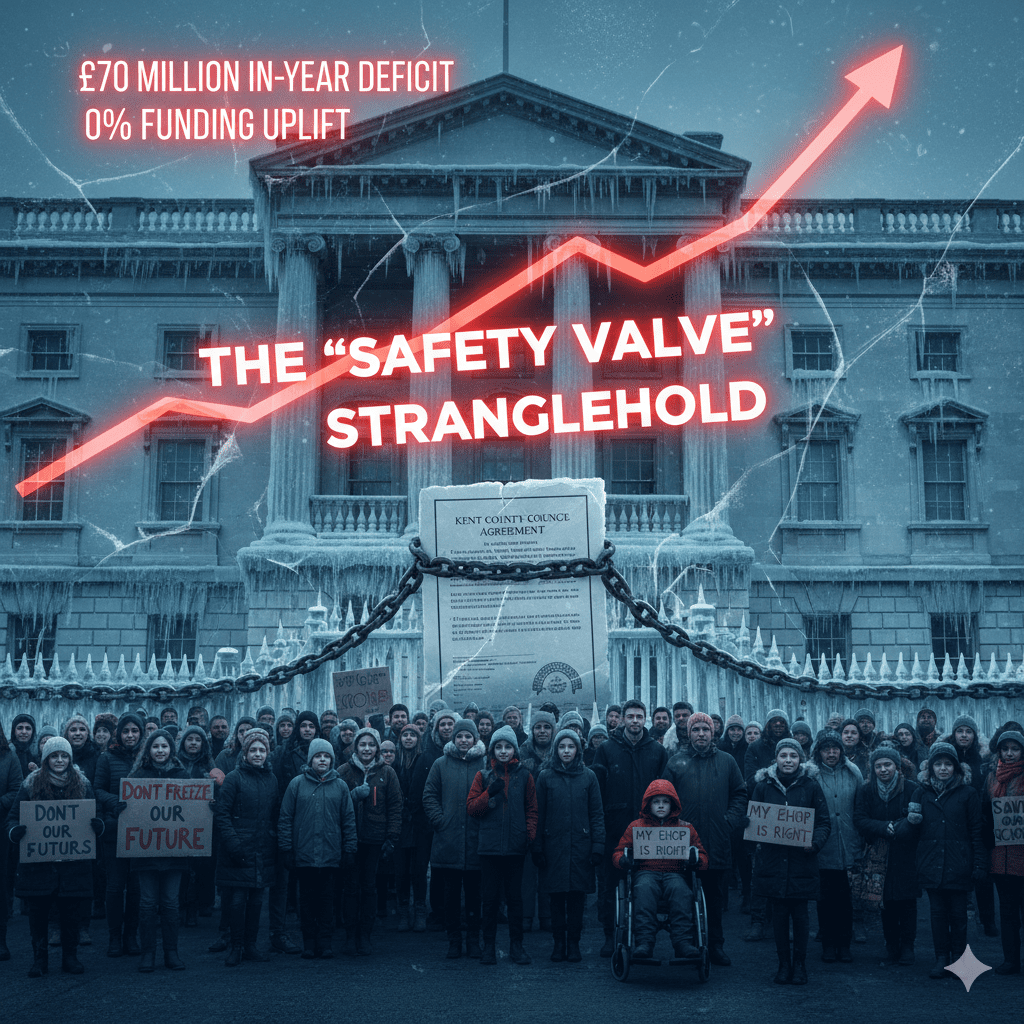
Yesterday, January 22, 2026, Kent County Council (KCC) set out the brutal reality of their position. They are facing an in-year deficit of £70 million for 2025/26 alone.
Usually, the government increases the High Needs Block funding every year to account for inflation and more children needing help. But for the 2026/27 cycle, that increase is zero.
- The Freeze: KCC will receive the exact same cash amount as last year, despite rising energy bills for schools and higher staff wages.
- The Trap: Because KCC is under a Safety Valve deal, they are legally prohibited from overspending to cover the gap. If they break the deal, they lose the DfE bailout money, potentially bankrupting the council.
The Impact on the Ground: “Gatekeeping” by Necessity
To meet their Safety Valve targets in this frozen financial climate, KCC is being forced to implement what campaigners call “aggressive gatekeeping”:
- The “Threshold” Rise: Reports suggest KCC is tightening the criteria for EHCP assessments, focusing only on the “most severe and complex” cases.
- Mainstream Mandates: A push to move up to 29% of children currently in specialist schools back into mainstream environments, often without the 1:1 support being transferred with them.
- The “Statutory Override” Deadline: A crucial accounting rule that lets councils keep SEND debt “off the books” expires in March 2026. After this date, Kent’s massive deficit must be recognized on its main balance sheet, threatening every other service from libraries to road repairs.
The Political Fallout
The situation has become a political lightning rod. Kent’s new administration is currently facing a £60 million to £100 million total budget gap for the next year. With a 4.99% council tax hike already planned, residents are asking why they are paying more for services that are being systematically “watered down” to pay off historical debt.
Safety Valve Watch 2026
- Kent’s Total Deficit: Forecast to reach £136m by March 2026.
- The Bailout Terms: KCC must contribute £82m from its own reserves/tax while the DfE pays £140m.
- The 2026 Freeze: First time in 5 years there has been a 0% uplift in the High Needs Grant.
- The Law: Over 98% of families who challenge these “Safety Valve” rejections in court still win, suggesting the council’s cost-cutting is frequently unlawful.