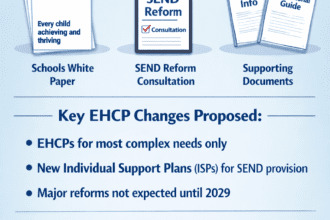
Sweeping changes are coming to the UK’s Special Educational Needs and Disabilities (SEND) sector, with the government preparing to introduce “digital support passports” and a new four-tiered support system.
The reforms, expected to be fully implemented by the 2029-30 academic year, aim to streamline support and curb spiralling costs. Here is the breakdown of what these changes mean for families and schools.
The New Four-Tiered Model
Under the proposed plans, children with additional needs will no longer immediately apply for an Education, Health and Care Plan (EHCP). Instead, they will move through a structured hierarchy:
- Universal Support: The baseline support available to all pupils in mainstream settings.
- Tiered Progression: If universal support is insufficient, pupils move through three increasingly intensive tiers of intervention.
- EHCPs as a Last Resort: Legal EHCPs will be reserved specifically for children whose needs cannot be met by the four tiers.
Note: Children born with complex, lifelong conditions (such as cerebral palsy) will still receive an EHCP from birth. However, those with developing needs will be required to navigate the tiered system first.
Digital Support Passports
To solve the “transition gap” where support is often lost when a child moves schools, every child with additional needs will receive an individual support passport. This digital document will:
- Follow the pupil from early years through to sixth form.
- Ensure immediate access to a child’s history and requirements for new teachers.
- Reduce the administrative burden on parents during school transfers.
Funding Shift: Moving Away from Individual Budgets
One of the most significant shifts involves how money is allocated. Currently, funding is largely tied to individual EHCPs. Under the new reforms:
- Collective Funding: Groups of schools will receive “pots” of money to commission services (like speech therapy or psychologists) for groups of children.
- School Autonomy: Schools will have more flexibility in how they spend their SEND budgets, though this will come with “significant requirements” for accountability.
- Mainstream Focus: The government is investing £3bn to create 60,000 SEND places within mainstream schools, signalling a push to keep more children out of specialist-only provision.
Why Now?
The reforms are driven by a looming financial crisis; the Office for Budget Responsibility forecasts a £6bn funding gap by 2028-29.
While the government aims to make “all teachers SEND teachers” via a new £200m training package, critics worry that pulling staff out of the classroom for training will further strain an already exhausted workforce. There is also significant anxiety among parents regarding whether existing EHCPs will be protected or if the bar for receiving help is being raised too high.
The full details are expected in a Schools White Paper scheduled for release in late February.
The Core Concerns: Tiers vs. Rights
1. The Dilution of Legal Protections
The biggest flashpoint is the transition from EHCPs (which are legally binding documents) to Digital Passports and Tiers (which may not carry the same legal weight).
- Parental Fear: Currently, an EHCP gives parents the legal right to sue a local authority if support isn’t delivered. There is a deep concern that the “four tiers” will act as a buffer to prevent children from reaching the legal protection of an EHCP.
- The “Gatekeeping” Effect: Advocates worry the tiers will be used as a cost-cutting tool to delay support, forcing children to “fail” through four different levels of intervention before they qualify for a plan that actually meets their needs.
2. The “Postcode Lottery” of Funding
Under the new plan, funding moves away from the individual child and into a “collective pot” for groups of schools.
- Educator Concern: Schools are worried that without funding being “ring-fenced” for a specific child, the money will be swallowed up by general school overheads or stretched too thin across a large group of pupils.
- Commissioning Gaps: If a group of schools is responsible for hiring their own speech therapists or psychologists, rural or struggling schools may find it impossible to recruit the necessary professionals, leaving pupils in those areas stranded.
3. The “Mainstream-First” Pressure
The government aims to move more children with SEND into mainstream schools to reduce the reliance on expensive specialist provision.
- Mainstream Suitability: Many parents argue that mainstream environments are often sensory-overload environments that are fundamentally unsuitable for some neurodivergent children, regardless of how much “SEND training” a teacher receives.
- Teacher Burnout: Educators have expressed concern that the £200m training package isn’t enough to compensate for the lack of Teaching Assistants (TAs) and specialized equipment needed to support high-needs pupils in a standard classroom.
4. Uncertainty for Existing EHCP Holders
The government has stated that only “effective” existing support will be protected, but has not defined what that means.
- The “Double System”: There is high anxiety that children who currently have an EHCP might have them “downgraded” to a Digital Passport or a Tier-4 status during the transition period, potentially losing 1-on-1 support or specialized transport.
Summary of Concerns
| Feature | Government Aim | Parent/Teacher Concern |
| Digital Passports | Better data sharing | Lack of legal enforceability |
| Four-Tier System | Clearer pathways | Delaying tactics / “Gatekeeping” |
| Collective Funding | Flexibility for schools | Loss of individual entitlement |
| Mainstream Focus | Inclusion & cost-saving | Inadequate environments for complex needs |
Credit inews.co.uk