Over 120 Charities Urge Ministers to Put Children’s Rights at the Heart of UK Law
Publication date: January 2026
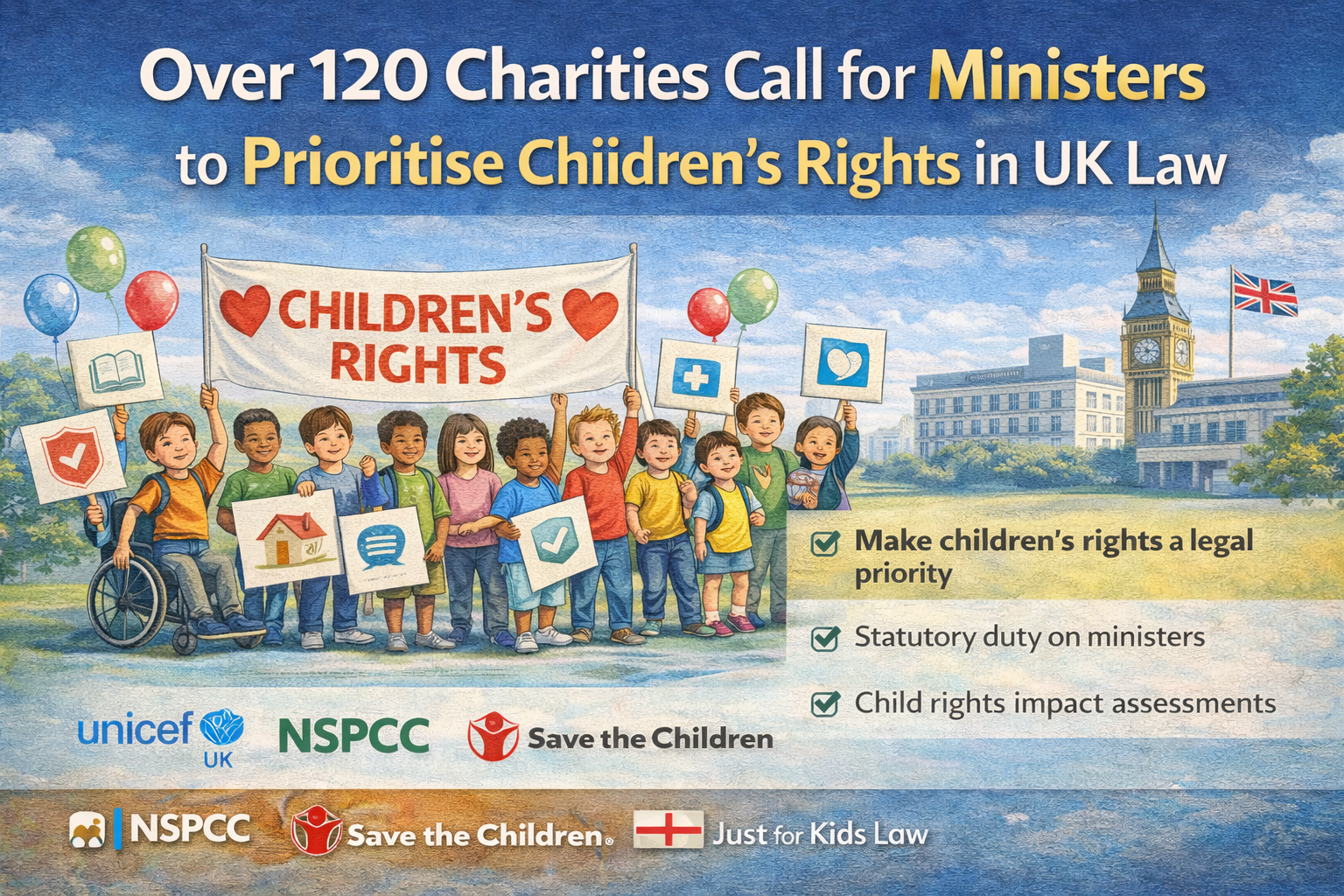
More than 120 charities and organisations working with children and young people have issued a united call for the UK Government to make children’s rights a legal priority, warning that England is falling behind other nations in how it protects and considers the rights of children in law and policymaking.
The coalition, which includes major organisations such as UNICEF UK, NSPCC, Just for Kids Law, Save the Children UK, and the Children’s Rights Alliance for England, is calling on Ministers to introduce a statutory duty to uphold children’s rights across government decision-making.
Their appeal centres on proposed amendments to the Children’s Wellbeing and Schools Bill, currently progressing through Parliament.
Call for Legal Change
The charities argue that while children’s rights are often referenced in policy discussions, they are not consistently embedded in law, leaving them vulnerable to being overlooked when key decisions are made on education, social care, healthcare, welfare, and public spending.
They are urging Ministers to support amendments tabled by Baroness Lister of Burtersett, which would:
- Require Ministers to explicitly consider children’s rights when exercising their functions in relation to children’s wellbeing, education, and social care
- Introduce a statutory requirement for Child Rights Impact Assessments, ensuring that proposed legislation, policies, and budget decisions are assessed for their impact on children before being implemented
Campaigners say these measures would help ensure that children’s rights are not treated as an afterthought, but as a core consideration across government.
Key Rights at Stake
The coalition highlights a range of fundamental rights they believe must be protected and promoted, including:
- The right to an adequate standard of living
- Access to healthcare
- Education
- Protection from violence and abuse
- Freedom of expression and the right to privacy
They argue that without clear legal duties, these rights can be undermined by policy decisions made without sufficient consideration of children’s needs or voices.
England “Falling Behind”
Campaigners warn that England is lagging behind other parts of the UK, particularly Wales and Scotland, where children’s rights are more clearly reflected in domestic law and public decision-making frameworks.
Longer term, the coalition is calling for the full incorporation of the United Nations Convention on the Rights of the Child — the United Nations Convention on the Rights of the Child — into UK law.
The UNCRC is a legally binding international treaty that sets out the civil, political, economic, social and cultural rights of every child under the age of 18. While the UK is a signatory, campaigners argue that without incorporation, children’s rights remain difficult to enforce in practice in England.
They say full incorporation would help deliver parity across the UK, ensuring that children in England receive the same level of legal protection as those in devolved nations.
Voices from the Sector
Sam Whyte, Associate Head of Policy at the NSPCC, said the proposed changes could have a significant impact on how decisions affecting children are made.
“To put children at the heart of our society means delivering the rights and protections they are entitled to. This must be an absolute priority for Government.
These proposals would make sure Ministers think about children’s rights every time they make a decision that affects young lives.”
He added that publishing impact assessments would force greater transparency about how children’s best interests and views are being taken into account.
Louise King, Co-Lead at Just for Kids Law, said recent years had shown how easily children’s rights can be overlooked.
“We’ve seen how children’s rights have been sidelined in major decisions, from Covid-19 policies to welfare and asylum reforms, often with damaging consequences.
These proposals would help ensure that children’s rights, interests and voices — especially those of the most disadvantaged — are not ignored.”
What Happens Next
The amendments are being debated in the House of Lords as part of the Bill’s committee stage. While the Government has not yet confirmed whether it will support the proposals, the scale and breadth of support from across the children’s sector has placed renewed pressure on Ministers to act.
Campaigners say that even incremental changes could represent an important step toward embedding children’s rights at the centre of UK law and policymaking, with the ultimate goal of ensuring that every decision affecting children is made with their rights, wellbeing and long-term interests firmly in mind.