By the Nothere Long News Desk
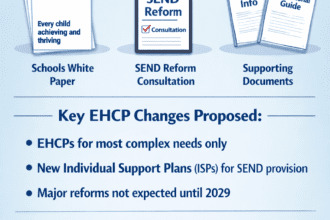
For over a decade, the Education, Health and Care Plan (EHCP) has been the “holy grail” for parents of children with special educational needs—a legally binding ticket to support in an often-underfunded system. However, a major policy shift is on the horizon. The government’s upcoming Schools White Paper is set to introduce a “four-tier” SEND model that aims to transform the EHCP from a starting point into a “last resort.”
Breaking Down the Four Tiers
The proposed reform seeks to replace the current binary choice (SEN Support vs. EHCP) with a graduated ladder of intervention. The goal is to catch children earlier, theoretically reducing the need for high-level legal intervention.
- Tier 1: Universal Support – Standard classroom adjustments that every school should provide as “best practice.”
- Tier 2: Targeted Support – Specific, short-term interventions (like literacy groups or speech therapy) managed internally by the school.
- Tier 3: Specialist Support – Involvement from external professionals (educational psychologists or therapists) without the formal legal framework of an EHCP.
- Tier 4: The EHCP – Reserved exclusively for the most complex cases where the previous three tiers have proven insufficient.
Digital Passports and Group Funding
Two major mechanical changes accompany this tiering:
- The Support Passport: A digital record that travels with the child. This is designed to end the “cliff edge” transition between primary and secondary school where support often vanishes or has to be reapplied for from scratch.
- Collective Funding: Instead of funding following an individual child via an EHCP, money may be allocated to “school hubs.” While this allows for quicker spending on early intervention, it raises concerns about transparency and how schools will prioritize competing needs within a single budget.
The Timeline: When Does This Land?
Change won’t happen overnight. We are looking at a phased transition:
- 2025–2026: Pilot programs and “Pathfinder” regions begin testing the digital passports.
- 2029–2030: The projected date for full, nationwide implementation of the four-tier system.
Analysis: Progress or Policing?
From the government’s perspective, this is about efficiency. By bolstering “Tier 2 and 3” support, they hope to stop the system from being overwhelmed by the current 26% surge in EHCP applications.
However, for the Not Here Long community, the scepticism is palpable. The EHCP is not just a document; it is a legal shield. By rebranding it as a “last resort,” there is a significant risk that children will be trapped in the lower tiers for years while their education suffers. Without the legal “teeth” of a Tier 4 plan, parents have little recourse if the promised “Targeted Support” fails to materialize.
The success of this reform hinges entirely on one thing: Trust. If schools are given the resources to make Tiers 1–3 truly effective, the system could become less adversarial. If not, we are simply looking at a new way to gate keep essential support