Councils Are Becoming the Frontline State — Here’s What That Means
Politics & Policy
When people talk about “the government”, they usually mean Westminster. But for most of us, government isn’t something we experience through speeches, Bills, or election campaigns. We experience it through our council.
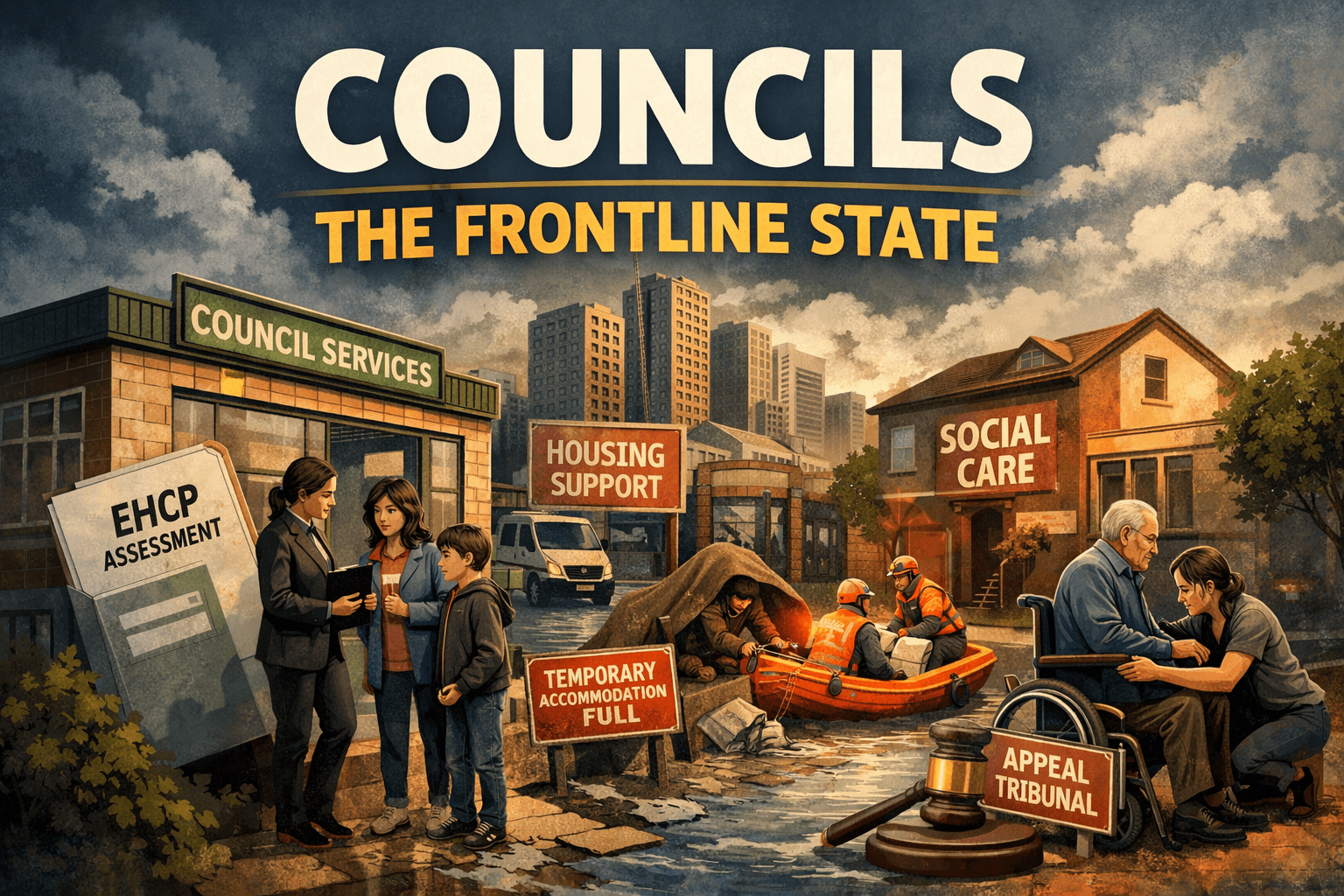
From housing to social care, from school transport to safeguarding, local authorities are increasingly the place where policy becomes real life. This is the quiet shift: councils are becoming the frontline state — the part of government that deals directly with people’s needs, crises and day-to-day services.
What does “frontline state” actually mean?
The frontline state is the part of the public sector that people encounter first, most often, and most directly. It’s where the state meets citizens.
That might be:
- a social worker assessing a child’s needs
- a council team responding to homelessness
- SEND teams processing EHCP assessments
- adult social care arranging support
- environmental health handling safety complaints
- a local authority stepping in during emergencies
Councils don’t just “deliver services” anymore. They manage the consequences of national policy decisions — often with limited control over the funding, rules, and demand.
Why is this shift happening now?
There are three big reasons.
First: demand is rising.
More people need help with housing, mental health, social care, and SEND support. This is driven by population change, cost-of-living pressure, and wider strain across public services.
Second: councils are carrying more responsibility.
Over time, local government has become the default safety net for problems that spill over from elsewhere. When the NHS is under strain, when schools struggle, when benefits don’t cover rent, councils pick up the pieces.
Third: money is tight.
Councils have faced years of financial pressure while costs rise. A major parliamentary report has warned that local government funding is not sustainable in its current form and that councils are forced to prioritise statutory services, leaving less for everything else.
Source: https://publications.parliament.uk/pa/cm5901/cmselect/cmcomloc/514/report.html
What does this look like in practice?
It means councils are increasingly forced into triage mode.
When budgets are squeezed, councils protect what they must legally provide — such as safeguarding and social care — and reduce what they can choose to provide, like youth services, libraries, community centres, and preventative programmes.
That creates a vicious cycle: cutting prevention often increases crisis demand later.
Why it matters for SEND, social care and families
For families navigating SEND, social care, or housing insecurity, councils aren’t a “local admin body”. They’re the gateway to support.
But councils are also balancing:
- legal duties
- rising caseloads
- workforce shortages
- increasing provider costs
- political pressure
- the risk of legal challenge
So decisions can become slower, stricter, and more defensive — not always because staff don’t care, but because the system is stretched.
Is local government being reorganised too?
Yes — and that adds another layer of disruption.
In some areas, local government is being reshaped into larger “unitary” authorities, with the argument that this improves efficiency and simplifies accountability. But reorganisations can also cause short-term turbulence and create distance between decision-makers and communities.
Background reading: https://www.instituteforgovernment.org.uk/sites/default/files/2025-09/reorganising-district-councils-local-public-services.pdf
What should readers watch for next?
If councils are becoming the frontline state, then the big questions aren’t just “what are councils doing?” but “what are they being asked to absorb?”
Watch for:
- more services moving to councils without funding following
- increased use of thresholds (who qualifies, who doesn’t)
- longer waits in assessments and reviews
- cuts to non-statutory services that prevent crisis
- rising conflict (complaints, tribunals, legal disputes)
Bottom line
Councils are now where many national policy failures and pressures end up landing. They are the frontline state — but often without frontline resources.
If government wants councils to hold the line on social care, SEND, housing and public health, it will need to treat local government as a serious pillar of the state — not a convenient backstop