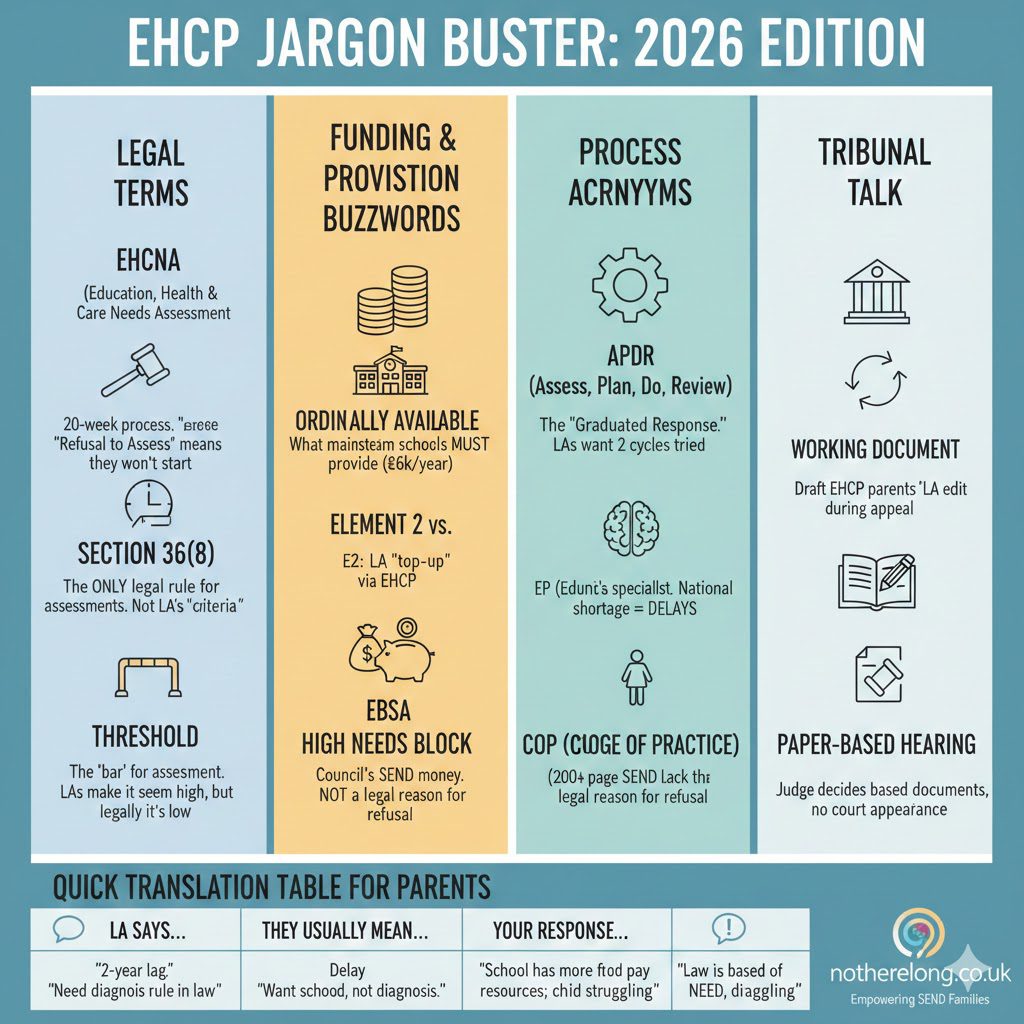
1. The “Legal Test” Terms
- EHCNA (Education, Health and Care Needs Assessment): The 20-week process where the LA investigates a child’s needs. A “Refusal to Assess” is the LA saying they won’t even start this process.
- Section 36(8): This is the specific part of the Children and Families Act 2014 that contains the legal rule for assessments. If an LA says “they don’t meet our criteria,” remind them that Section 36(8) is the only criteria that matters legally.
- Threshold: The “bar” a child needs to jump over to get an assessment. LAs often try to set this bar very high, but legally, it is actually quite low.
2. The “Funding & Provision” Buzzwords
- Ordinarily Available Provision (OAP): The support that every mainstream school is expected to provide from its own budget (usually up to £6,000 per year). If an LA refuses an EHCNA, they will often say: “Needs can be met through Ordinarily Available Provision.”
- Element 2 vs. Element 3: * Element 2 is the school’s own SEND budget (£6k).
- Element 3 (Top-up funding) is the extra money the LA provides via an EHCP.
- “High Needs Block”: The pot of money the Council has for SEND. They might mention this being “overspent” to discourage you, but legally, a lack of money is not a valid reason to refuse an assessment.
3. The “Process” Acronyms
- APDR (Assess, Plan, Do, Review): Also known as the “Graduated Response.” The LA wants to see that the school has tried at least two cycles of this before they step in.
- EP (Educational Psychologist): The specialist who looks at how a child learns. In 2026, there is a national shortage of EPs, leading to the “Educational Psychologist Crisis” often cited for delays.
- EBSA (Emotionally Based School Avoidance): Formerly called “school refusal.” This is when a child cannot attend school due to anxiety or unmet needs.
- COP (Code of Practice): The “Bible” of SEND law. It’s a 200+ page document that tells LAs what they must do.
4. The “Tribunal” Talk
- Working Document: A draft version of the EHCP that parents and the LA “edit” together during an appeal to try and reach an agreement before the court date.
- Bundle: The giant pile of PDFs (reports, letters, evidence) that the Tribunal Judge reads.
- Paper-Based Hearing: When a Judge decides your case just by reading the “Bundle,” without you having to appear on camera or in person.
Quick Translation Table for Parents
| When the LA says… | They usually mean… | Your response should be… |
| “The child hasn’t made a 2-year lag.” | “We have a secret rule that they must be 2 years behind.” | “Legally, there is no ‘2-year lag’ rule in the Children and Families Act.” |
| “We need a formal diagnosis first.” | “We want to delay the process.” | “The law says you must assess based on need, not a medical diagnosis.” |
| “The school has more to do.” | “We want the school to pay for it, not us.” | “The school has exhausted their resources and my child is still not progressing.” |