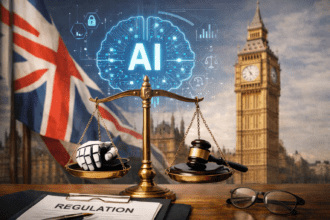
The UK Government, in conjunction with industry bodies and educational institutions, is actively developing and implementing a strategy to navigate the profound impact of Artificial Intelligence (AI) on the national labour market. This ongoing initiative, primarily driven by the Department for Science, Innovation and Technology (DSIT) and the Department for Education, aims to boost productivity, address skills gaps, and ensure workers across the UK are equipped for an evolving economy, ultimately safeguarding the nation’s competitive edge in the global AI race.
Context: AI’s Dual Impact on the UK Workforce
The advent of AI presents both immense opportunities and significant challenges for the UK’s economic landscape. While AI is poised to enhance productivity, automate routine tasks, and create new industries, it also necessitates a fundamental rethinking of traditional employment models and skill requirements. The UK has long grappled with a ‘productivity puzzle’ and persistent skills shortages in key sectors, issues that AI integration could either exacerbate or help resolve depending on proactive policy responses. The government’s ambition to position the UK as a global AI superpower underscores the urgency of preparing the workforce for this technological shift.
Recent reports from organisations such as the Office for National Statistics (ONS) and major consultancies like PwC highlight the potential for AI to automate a significant percentage of current job tasks, while simultaneously generating demand for new, often higher-skilled, roles. This necessitates a strategic focus on reskilling and upskilling to ensure a smooth transition and equitable distribution of economic benefits.
Policy Pillars: Skills, Productivity, and Adaptation
The government’s multifaceted strategy largely revolves around three core pillars: robust skills development, fostering AI-driven productivity gains, and ensuring worker adaptation and protection. These areas are being addressed through a combination of funding, regulatory guidance, and collaborative initiatives.
Investing in Skills Development for an AI Future
A central tenet of the government’s approach is the expansion and adaptation of the UK’s education and training infrastructure. Initiatives include bolstering digital skills programmes from primary education through to adult learning. The Department for Education is promoting T-Levels and apprenticeships with a strong digital and AI component, aiming to create clear pathways into tech-enabled careers. Additionally, lifelong learning frameworks are being encouraged, with a focus on accessible reskilling programmes for those in jobs at higher risk of automation. This includes funding for Level 3 qualifications and skills bootcamps designed to rapidly equip individuals with in-demand digital and AI-related competencies. Universities are also receiving support to expand AI-specific postgraduate courses and research, cultivating high-level expertise.
Leveraging AI for Enhanced National Productivity
The government views AI as a critical driver for improving the UK’s productivity. Policies aim to encourage businesses, particularly Small and Medium-sized Enterprises (SMEs), to adopt AI technologies to streamline operations, innovate products, and enhance service delivery. Grant schemes and innovation hubs are being explored to facilitate AI adoption, ensuring that the benefits of automation and data-driven insights are realised across various sectors. The focus is on AI as an augmentative tool, enhancing human capabilities rather than solely replacing jobs, thereby leading to higher-value work and improved economic output. The long-term goal is to reverse the UK’s stagnant productivity growth, linking AI adoption directly to economic prosperity.
Protecting Workers and Facilitating Adaptation
Recognising the potential for disruption, the government’s strategy also includes provisions for worker adaptation and protection. This involves ongoing dialogue with trade unions, industry bodies, and labour market experts to understand the evolving nature of work. While direct statutory regulation for AI’s impact on employment is still developing, existing labour laws are being reviewed for their applicability in an AI-driven economy. Emphasis is placed on transparency in algorithmic decision-making, particularly concerning hiring, performance management, and dismissal, to mitigate bias and ensure fairness. Public sector AI use is also under scrutiny to ensure ethical deployment and accountability, setting a precedent for broader adoption. The goal is to foster a flexible labour market that can absorb changes while providing adequate support and opportunities for those affected by technological shifts.
Expert Perspectives and Data Insights
Analysis from organisations like the World Economic Forum suggests that while AI may displace some jobs, it is also expected to create millions of new ones globally, particularly in areas like AI and machine learning specialists, data analysts, and robotics engineers. The UK’s challenge lies in ensuring its workforce possesses the necessary skills to fill these emerging roles. A report by Nesta highlighted the significant potential for AI to augment professional services, healthcare, and creative industries in the UK, provided the right investment in human capital is made. Policy think tanks such as the Institute for Government have advocated for clearer governmental accountability and oversight mechanisms to ensure that AI policy translates into tangible benefits for workers and the economy, rather than exacerbating existing inequalities.
Implications for Businesses and Individuals
For UK businesses, the message is clear: embracing AI is no longer optional but a necessity for competitiveness. This requires not only investment in technology but, crucially, in the continuous training and development of their workforce. Companies that proactively upskill their employees in AI literacy and complementary ‘human’ skills like critical thinking, creativity, and emotional intelligence will be best placed to thrive. For individuals, the imperative for lifelong learning has never been stronger. Workers will need to actively seek opportunities to adapt their skillsets, viewing continuous education as a fundamental aspect of their career progression. The shift implies a move away from purely task-based roles towards those requiring complex problem-solving and interpersonal interaction, often augmented by AI tools.
Looking ahead, the success of the UK’s AI labour market strategy will hinge on sustained cross-departmental collaboration, agile policy adjustments, and continuous engagement with industry and education providers. Key areas to watch include the rollout of specific funding for AI skills programmes, the development of clearer regulatory guidance on AI’s impact in the workplace, and the monitoring of labour market data to identify emerging trends and adjust policy accordingly. The evolution of this strategy will be crucial in determining whether the UK harnesses AI to unlock widespread prosperity or faces widening skills gaps and economic disparities.
Source: Department for Science, Innovation and Technology (DSIT), Department for Education, Office for National Statistics (ONS), PwC, Nesta.
Published by Notherelong.