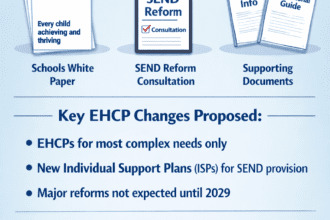
If you feel like you’ve been living on a knife-edge lately, you aren’t alone. As we move into February 2026, the SEND community is holding its collective breath. The long-delayed Schools White Paper is finally due to land on the Education Secretary’s desk this month, and the rumours swirling around Westminster have parents, teachers, and advocates deeply concerned.
At Not Here Long, we’ve spent the last two weeks sifting through the noise to find out what is actually happening. From “red line” warnings issued by the UK’s biggest charities to a massive new investment in teacher training, here is the full breakdown of the news that matters to your family.
1. The Fight for Our Legal Rights: The “Red Line”
The biggest story of the fortnight is the growing tension between families and the Department for Education (DfE). A coalition of over 130 charities—including IPSEA, Contact, and the Disabled Children’s Partnership—has issued an urgent plea to the government: Do not touch our children’s legal rights.
Our Take: For years, the government has whispered about “reforming” the Education, Health and Care Plan (EHCP) system to make it “more sustainable.” In plain English? They want to spend less money. Leaks suggest the White Paper might introduce a “tiered” system where EHCPs are reserved only for the most “severe and complex” cases.
This is a dangerous game. By narrowing the definition of who deserves a legal plan, the government risks creating a “lost generation” of children who are neurodivergent or have moderate disabilities but don’t meet an arbitrary new “complexity” bar. The charities are right to call this a red line. An EHCP isn’t a luxury; it’s a legal lifebelt in a sea of underfunded mainstream provision. Without the legal right to appeal to a Tribunal, parents are left powerless.
2. The £200 Million Training Gamble
In mid-January, Bridget Phillipson announced a “landmark” £200 million investment to train every teacher in England on SEND support. The goal is to make mainstream schools so inclusive that families won’t feel the need to fight for an EHCP.
The “Tips and Tricks” Reality: On paper, this sounds great. Training staff in adaptive teaching and assistive technology is long overdue. But let’s be honest: you can give a teacher all the training in the world, but if they have 32 children in a class, two of whom are in crisis, and zero Teaching Assistants to help, that training remains a theory.
At Not Here Long,, we believe that “inclusion” shouldn’t be a budget-cutting exercise. True inclusion requires staff, space, and specialist equipment, not just a few hours of online CPD for an already exhausted teacher. We welcome the investment, but we’re watching closely to see if it’s backed up by actual “boots on the ground.”
3. The Ombudsman’s Warning: Systemic Failure is the New Normal
While the government talks about the future, the Local Government and Social Care Ombudsman (LGSCO) has reminded us of the grim present. A recent investigation into Sandwell Council revealed that over 1,100 Annual Reviews were overdue.
Why This Matters: Sandwell admitted they made a “strategic decision” to prioritize new applications over reviewing old ones. This is happening across the UK. When your child’s Annual Review is ignored, their support is frozen. If they’ve outgrown their sensory strategies or need a different school transition, they are stuck in a plan that no longer works.
This Ombudsman report is a smoking gun. It proves that local authorities are choosing which laws to follow and which to ignore. It reinforces why we must keep our legal protections; if councils are failing with the current laws in place, imagine the chaos if those laws are weakened.
What Can You Do Right Now?
The next few weeks are critical. As the White Paper is published, there will be a consultation period. This is your chance to be the “difficult parent” the system is afraid of.
- Check your dates: If your Annual Review is overdue, use our “Overdue Review” Template to lodge a formal complaint.
- Stay Loud: Join the #SaveOurRights campaign on social media. The government needs to know that SEND parents are organized, informed, and we aren’t going anywhere.
- Keep your Paper Trail: As we always say, if it isn’t in writing, it didn’t happen. Use our Communication Log to track every delay and every broken promise.
The Bottom Line: The government wants a “national conversation” about SEND. Let’s make sure they hear us. We don’t want a system that is “sustainable” for the Treasury; we want a system that is successful for our children.
Not Here Long,