The Department for Education has published a new 10-year Education Estates Strategy, signalling major changes to how school buildings are funded, maintained and repurposed across England.
The strategy confirms that the current Condition Improvement Fund (CIF) will be replaced by autumn 2028, ending the long-standing competitive bidding process used by standalone academies and small multi-academy trusts to secure capital funding.
End of Competitive CIF Bidding
Under the new model, schools will no longer be required to submit full capital bids for maintenance funding. Instead, allocations are expected to be driven by condition data and national priorities, moving towards a more centrally planned, data-led system.
The government argues this will reduce bureaucracy and ensure funding is directed where building condition risks are highest.
New National Estate Data System
A new “Managing Your Education Estate” digital platform will launch this month, consolidating guidance, estate data and funding tools in one place. A strengthened data reporting regime for responsible bodies is expected to follow next year.
This signals a shift towards tighter oversight of school estate condition and long-term strategic planning at national level.
Framework for Surplus Land and Buildings
The strategy also introduces plans for a decision-making framework to help schools and local authorities manage surplus land and underused buildings more effectively.
With falling pupil numbers in parts of England, the government suggests excess space could be repurposed for community services such as family hubs, health provision, or youth services.
Implications for SEND and Inclusion
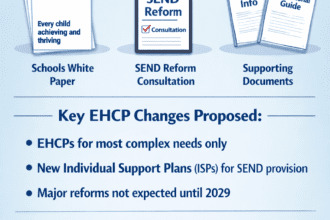
While detailed SEND reforms are expected separately in the forthcoming Schools White Paper, the estates strategy includes an ambition for all secondary schools to develop “inclusion bases” — dedicated spaces intended to bridge mainstream and specialist provision.
Details on funding, staffing and accountability for these bases remain unclear.
What This Means
- Competitive capital funding bids will be phased out by 2028.
- Building condition data will play a larger role in funding allocation.
- Surplus school land may be formally integrated into community infrastructure planning.
- Inclusion infrastructure is being positioned as part of the national estates strategy.
The reforms mark one of the most significant structural shifts in school estate management in over a decade.
Source: Schools Week
Published by Notherelong.