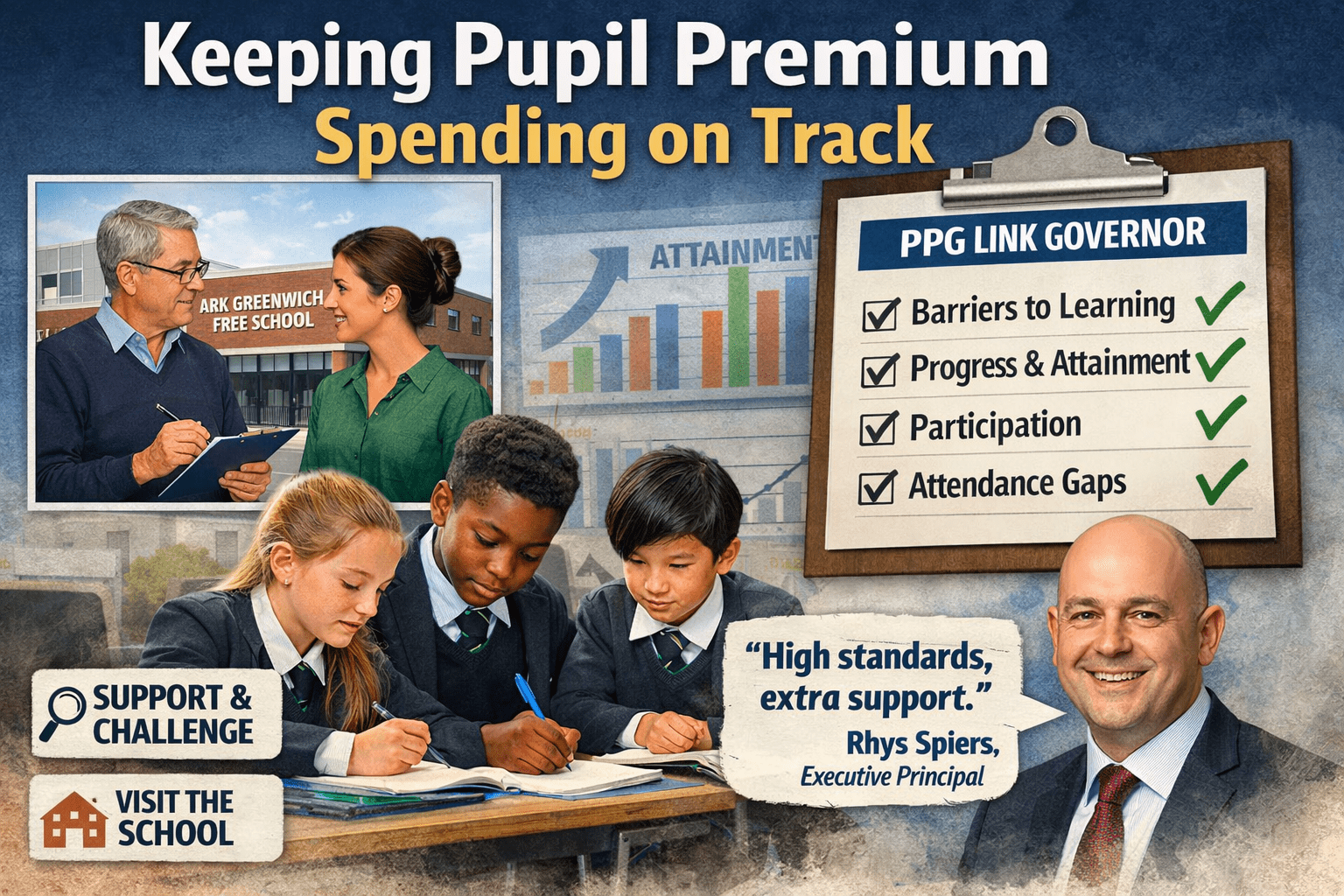
A Pupil Premium link governor at Ark Greenwich Free School (AGFS) has set out how governors can move beyond “rubber-stamping” and instead actively test whether funding decisions are improving outcomes for disadvantaged pupils.
In brief
- A link governor explains how they challenge and support leaders to prove Pupil Premium spending is working.
- Key focus areas include barriers to learning, measurable success criteria, attendance gaps, and pupils’ wider participation in school life.
The context at Ark Greenwich Free School
AGFS is a mixed secondary school in south-east London. Its catchment includes communities within the 2nd to 4th deciles of deprivation nationally (2019 Index of Multiple Deprivation). The school has around 600 pupils, with 42% eligible for Pupil Premium, and serves a high proportion of students with additional learning needs and English as an additional language.
The school’s approach starts by naming the barriers disadvantaged pupils face, then building provision around them. These include lower confidence and oracy, weaker literacy and numeracy, challenges with independent study and organisation, reduced parental availability for academic support, limited cultural capital, fewer resources for study at home, and lower attendance.
A “PPG first” approach
AGFS describes its strategy as “Pupil Premium Grant (PPG) first”: begin with need, set clear outcomes, and spend with intent. The school reports strong attainment for pupils eligible for Pupil Premium, arguing that well-designed disadvantage strategies can also benefit pupils with SEND rather than being a separate bolt-on.
What the link governor actually does
The link governor role is described as a mix of support and challenge: raising the profile of disadvantage in governance conversations and pushing for evidence that planned actions are delivering results. At Local Governing Body (LGB) meetings, governors review the impact of spending on targeted groups by analysing attainment and progress against peers and looking at patterns over time.
The scrutiny is not purely academic. The governor also checks whether disadvantaged pupils are fully included in the wider life of the school—performances, trips, enrichment and extra-curricular opportunities—because participation can be an early indicator of belonging, confidence and aspiration.
Throughout the year, governors track a small number of “signal” measures—especially attendance gaps between Pupil Premium and non-Pupil Premium pupils—and use them to probe what is working, what is not, and what needs changing.
“Great outcomes for PPG is about having high standards and not lowering the bar, but providing additional support to meet that bar.”
— Rhys Spiers, Executive Principal, Ark Greenwich
Advice for governors: get into school
The clearest takeaway is practical: spend time on site. Meeting the Pupil Premium lead, reviewing performance information, and understanding what interventions look like in real classrooms helps governors ask sharper questions and avoid relying on assumptions. The governor also stresses that a high proportion of Pupil Premium pupils should not be treated as a reason for lower ambition—strong outcomes are possible with a disciplined, evidence-led strategy.
Source: https://teaching.blog.gov.uk/2025/11/07/governors-pupil-premium-strategies/
Published by Notherelong.